Art Reviews: Darryl Pfitzner Milika and Jimmy Pike

Art Reviews: Darryl Pfitzner Milika and Jimmy Pike

Darryl Pfitzner Milika’s Sky, Land and Beyond: Expanding identity

Milika is an artist and keen amateur astronomer. His photography and mixed media work express a fascination with landscapes uniting land and sky. Some of the photographs are straight-up astronomical photos, while most of the rest depict reflections of sky in water. Milika, who did not grow up with Dreaming stories, is wary of referencing Aboriginal lore directly in his work, but his most striking photograph is of the emu in the Milky Way, a figure of negative spaces within star fields. The mixed media work, of steel animal sculptures marching over painted landscapes, was less immediately interesting, apart from Ants, which brought to mind a union of Mars and Earth via the ant-creatures of Quatermass and the Pit. Until 11 November. Images available at the Tandanya website.

Jimmy Pike’s Desert Psychedelic

Pike brought a fluorescent palette to Western Desert art. This retrospective of the late artist includes screen prints, clothing, and long sheets of fabric hung from the high ceiling of the main gallery. Much of the patterning is familiar if you’ve seen other Western Desert art, but the colours bring to mind the best and worst of the Eighties fluoro fascination. There are also quieter black and white works. Some pieces are presented with descriptions of the stories they depict while others have titles which remain untranslated. A few key works need no translation, such as a sinuous print of desert dunes and vegetation. Until 25 November. Images available at the Tandanya website.

Film Review: This Is Roller Derby

Film Review: This Is Roller Derby

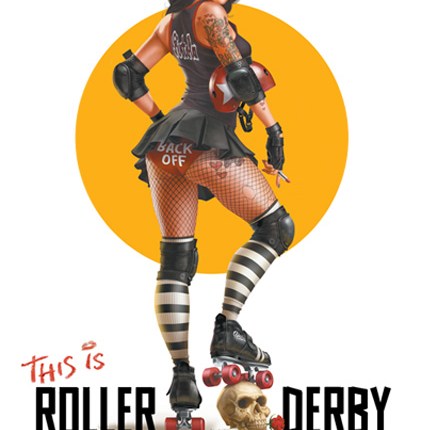
Modern roller derby is a sport that’s part athletics, part violence and part theatre. The all-women teams of Adelaide Roller Derby start each match with a performance to intimidate their enemies and rouse their fans, rising from a grave as the Wild Hearses team, or swimming with sharks as the Salty Dolls. Their costumes draw from a scrapbag of movie and other cultural references, including skeletal face paint, frilled bloomers, fishnets and leopard prints. Skaters have their derby names emblazoned on their backs, often a pun like “Ginger Nut Risk It” or “Sin & Tonic”. Then the match starts, and high-velocity skaters tear around an oval track, taking the hands of team-mates to swing them on faster, and using their hips to smash the opposition from the track. It’s exhilarating to watch.

Australian director Daniel Hayward spent four years and a shoestring budget filming a documentary on roller derby. It’s enthusiastic but uneven. He speaks with the women who restarted the sport in 2001 after a confidence trickster claimed to be setting up a league in Austin. From there it’s spread across the globe. Austinite Barrelhouse Bessie brought it with her when she moved to Adelaide and teams are now spread across Australia. Hayward mixes interviews within a loose thematic structure, but provides a narrative hook by documenting the difficult start of a new team in Ballarat. With no external funding and all the usual problems of volunteer-run organisations, the team struggles first to exist and only second to win matches.

Adelaide derby fans will welcome the extensive interview with Barrelhouse Bessie, the scenes of the Adeladies playing against Victoria in Skate of Origin matches, and interior shots of the Wheatsheaf Hotel. As an introduction to the sport, it’s passable, even though the rules aren’t explained until halfway through the movie. As an introduction to a cultural phenomenon, it glides away from the hard questions, such as the uneasy boundary zone between the fetishisation of the players and its punk attitude to self-expression.

Film Review: Iron Sky

Film Review: Iron Sky

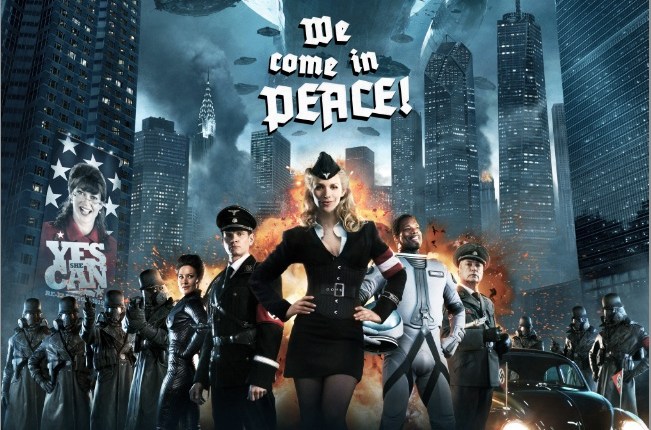
It would be hard to describe the movie Iron Sky if the sentence “Nazis from the Moon invade Earth” didn’t exist because that is the movie and it does exactly what it says on the tin. Iron Sky is a 2012 comic science fiction action film with surprisingly high production values and a pretty good cast who all turn in a good performance. It’s a little sad then that such promise didn’t quite follow on to the script. The first 20 minutes of the film in no way prepare you for the sheer level of insane film homage, action and silliness that is going to follow so it is essential that you read the following advice for viewing:

When watching Iron Sky, continue past the first 20 minutes!

The film is set in 2018 and President Palin (??) has sent people back to the Moon to give her an increased chance of re-election. This is the most sensible that the film every is and it goes every which way from that. Many, many other films are referenced throughout this movie. I must be honest that while I was expecting Dr Strangelove and Star Wars shout-outs, the Downfall parody caught me slightly off guard. I have to go and watch the movie again because a lot of these came and went so quickly that I had a strange feeling of deja vu for a reasonable fraction of the film. I did replay some key scenes and laughed a fair bit at some of the sillier aspects.

Oh, and if you happen to be North Korean, don’t watch this film. They are a little insensitive towards you. I suppose the same is true if you happen to be a hyper-sensitive Moon Nazi leader (as played by everyone’s favourite vampire/old German stalwart Udo Kier). There are some pretty harsh political statements about the way that the world currently works – I suspect that the most conservative might find some parts of this offensive. I did like the gentle self-deprecating dig at the Finnish, towards the end. It was a very nice touch.

The lead actors have a lot of fun. Julia Dietze and Götz Otto devour their roles as Moon Nazis, Christopher Kirby almost manages to avoid snickering for his role as a moon-bound male model who is conveniently African-American and Stephanie Paul almost pulls off a convincing Palin. Peta Sargent has a lot of fun with her role as PR director and… well, I won’t spoil it but she has other roles and some astounding hair.

This film was partially fan-funded, after a teaser reel went to Cannes and secured some more traditional film funding. Some of the work inside the movie itself is crowd sourced, especially the animation and modelling, indicating the state of maturity outside of the traditional studio system. The funding and production is a Finnish/German/Australian production, along with the support of the developing participatory cinema community. There’s some talk of a prequel/sequel but I don’t really see the point. This starts and ends well – it’s hard to see what could be added.

Scriptwise, this is as B as it comes. Production values, acting and overall enjoyability move this up the scale. I’d happily watch this again. Don’t wait for this to hit the free-to-air. If you haven’t seen it yet, check it out.

Rapid Fire: The ‘New’ Popular Penguins

Rapid Fire: The ‘New’ Popular Penguins

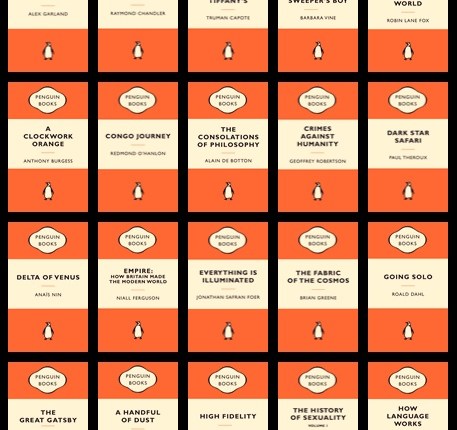
Penguin Books have been around since 1935, when Allen Lane couldn’t find a decent book at the train station, but in these increasingly difficult times for selling physical books (increasing costs, supply issues and competing with the electronic and international market) Penguin have been pushing out the Popular Penguins. You’ve probably seen them in bookshops all over the place: a distinctive and slightly old-fashioned orange cover and a cover price of $9.95. (I got a sweet deal at the airport of 3 for $25 – $8.33 for a book, hooray!)

What’s so good about this? The range is fantastic and, at this price, it means that you can catch up on all of those books that you always thought that you should have read (or said that you did read) and not have to pay $30 for the privilege. I’m surrounded by books that I haven’t read for years and ones that I’ve always wanted to read. Marcus Aurelius’ “Meditations” sits next to Burroughs “Junky”, on a stack that includes Capote, Collins, de Botton and Feynman.

Need a quick read of something with a little bit of substance but don’t want to spend too much? Look at the Popular Penguins website for a list of books that you can go and buy from a real, live bookseller!

Game Masters @ACMI (Melbourne, until 28 October, 2012)

Game Masters @ACMI (Melbourne, until 28 October, 2012)

The Australian Centre for the Moving Image (ACMI) is host to the Game Masters exhibit, showcasing the work of 35 learning video game designers, spread across a large interactive area that features the arcade games that preceded the home computer and console, the game changers that brought the arcade into the home and the rise of the Indies, independent game designers who are changing the way we play, without a large production company behind them.

Team Falkner attended the exhibit on the 14th of July, taking on a feisty Saturday crowd to look at the development of the games over time. The way into the exhibit takes you past the arcade games of yesteryear. I got in a quick game of Centipede but the queues on most of the other games were a little longer than my level of interest in failing to impress the crowd gathered around. Asteroids was there and it’s astounding how popular a black-and-white game with simple graphics can be – when the game is good!

(One piece of advice: the machines and consoles are in constant use. If you are the kind of person who doesn’t like to handle human warm stuff, then bring hand wipes. If you’re even vaguely germophobic, this is a spectator event for you.)

From the realm of the Arcade Heroes, we moved into the Game Changers: those games, companies and designers who made giant changes to the way that we game. What a range and everything was playable! From World of Warcraft and the way it revolutionised the massively on-line experience, to the comedic nonsense of Sonic the Hedgehog, the sweeping open exploration of Shadow of the Colossus or (my favourite) vast quantities of the design documents of Deus Ex, with Warren Spector’s original design documents. Like Rock Band? It’s here. Lost a week to The Sims? Watch an interview with Will Wright. If you have played games in the past 10 years, you’ll find something here to make you go “Wow!” (No pun intended.) If you’ve been developing hand cramps from over-playing for more than two decades, like me, then your jaw will be on the floor for most of it. There’s a big interview bank where you can relax and listen to your heroes talking about their ideas, drive and vision.

From the Game Changers, we moved sideways into the Indies section. Playing outside of the major studios and turning out fantastic games with far less dependence on the big resources, we see games that are quirky, even downright weird, and establishing new genres. There was a pretty diverse range here, from PaRappa the Rapper to Fruit Ninja and Braid. Again, everything here was playable, and, because of the nature of the games, it was often hard to tell if someone was playing, watching or just experiencing.

A giant dance studio is set up in one corner, next to the Singstar booth and the Rock Band facility: all full, with queues, of people jamming, singing and just having fun. While we were there, a girl in a giant bunny onesy was belting it out with a friend in the Singstar booth while a father and son tried, valiantly, to save family honour on the dance floor.

 If you like games, playing, watching or just thinking about them, ACMI’s Game Masters is a great way to spend a couple of hours. Admission is $22/$17.50/$16/$11 for Full/Conc/ACMI Member/Child (4-15) and there are family deals as well. It’s pretty family friendly and there’s a lot for the junior family members to do but, if you really want to get involved, you probably want to find someone to look after the really young kids. Check out their website here.
Definitely recommended and an A event on the Velour Future semi-random rating guide! Get there before the end of October!