Upcoming gigs and fun things to do (poetry edition) – August, Early September, 2026

Upcoming gigs and fun things to do (poetry edition) – August, Early September, 2026

Hey there, Nick fan(s). I’m a little more active on the poetry scene for the next few weeks. It’s a bit of a mixed bag and I hope there’s something for everyone! We’ve got short, tight, spoken word/poetry sets, we’ve got storytelling, we’ve got a full on 10-15 minute set as part of a slam heat. Three different forms? In this economy?

BY GRABTHAR’S HAMMER … … … WHAT … A SAVINGS.

Dr. Lazarus, played by Alexander Dane (Alan Rickman)

Thursday, 13 August, 6pm sign-up, 7pm show, Ellipsis Two Year Anniversary Spoken Word – Arthur Art Bar, Currie Street, City.

Ellipsis is pretty busy these days but we’ll see if I can get a 5 minute slot to present a couple of poems I’ve had hanging around since March. It’s the two year anniversary of Ellipsis so come along and support poetry, spoken word, and the local art community. Shout out to the amazing Ellipsis organisers, Pam and Jazz!

Thursday, 20 August, from 7:30pm, TenX, “Stolen” – The Jade, Flinders Street, City

TenX is a free storytelling event that runs once a month and nine people stand up and tell a story, up to ten minutes long, based on a theme chosen for that month. This month’s theme is “Stolen” and I have a slot! No idea when it will be but all the stories will probably be interesting so come along and hear cool stories that fit into a 10 minute window.

Friday, 4 September, 6:30pm, Poetry Slam Heat 5 Feature Poet – Woodcroft Library, Bains Road, Morphett Vale.

This is not one of the actual competitive slam heats, some ludicrously nice people nominated me for a 10-15 minute set at Slam Heat #5. Come along to the near south and watch some excellent people hit the stage with powerful slam and passion, and then politely clap when I finish my set and shuffle off stage…

The management have asked me to confirm that this will not be a 15 minute instance of my infamous NANTUCKET LIMERICK CYCLE. Well, they can ask…

Thanks, Fallout 4, I’ll see you on the next playthrough.

Thanks, Fallout 4, I’ll see you on the next playthrough.

Long time, no post. I thought I’d wake this blog up with a post about gaming, as I started playing PS games again after about an 18 month hiatus. I had been getting quite involved in online team games like Division 2 and Helldivers 2 before I quit back in 2025 and I was a little worried about spending that much time gaming when I dived back in. I decided to take another crack at Fallout 4.

My first FO4 run

I had dabbled in the first two Fallouts, totally missed 3 and New Vegas, and started playing FO4 around the time that it was really exploding with the pipboy merch and the like. Being an older gamer with very few twitch reflexes left and starting from a basis of “clumsy”, I played my usual Charisma Sniper build: lots of build points spent on making dialogue exchanges productive and an appropriate level of accuracy and stealth skills to allow you to resolve your non-dialogue issues from a safe distance.

I played that game for about 200 hours, heavily teamed with Piper, avoided most of the BoS, was really really disappointed with my son, sided with the Railroad (although I regretted it later), and reached a point where everything could be resolved with 1-2 shots from the 50Cal sniper’s rifle, without wearing power armour. I’d charged aggressively into story pursuit, which meant that it took me quite a few attempts to defeat Kellogg as I had carelessly not saved for a while and my quicksave had me just before his dialogue started. Eventually, my build caught up with my aggression and exploding head disease started to affect many Raiders, Supermutants, and other villains.

But I reached a point in the game where the overall dreariness of the surroundings was just too much. I had built some nice places but PS4/5 mods weren’t that extensive and I couldn’t actually make many things look much better. I’d reached a point where I didn’t have much to achieve and the overall aesthetic was getting to me. I dismissed Strong, my companion of the time, stood my character on one of the bridges of Sanctuary, facing the sunset, and switched off.

The latest FO4 run

I turned the (now) PS5 back on a few months back and started messing around with FO4 again, in roughly 1 hour blocks. This was enough time to do some things, face some challenges, but not so much that it would cut into my life again, unlike the 2-3 hours I’d been committing to Helldivers 2 squad play back just before the Illuminate showed up.

Once again, I built a character who was agile and perceptive, charismatic, and this time I pumped intelligence to get the benefits of rapid exp rise. This time, there were far more expansion packs available for PS so I had Far Harbor, NukaWorld, plus Contraptions and all the others. This allowed me to delay doing the main story for a long time, in fact, I regularly stumbled over parts of other stories and had to redo them (Nick Valentine had amnesia for the second time I saved him).

I resolved Far Harbour, worked for the Railroad, did a lot of side quests, killed one or two people in really weird hats, and had got to the point where I was about to teleport into the institute – having not made any real progress on the Sean questline, despite being level 69. My settlements were well protected, I had a 50Cal ammo plant I fed with copper and lead, and I had even started some minor stuff for the BoS to see what that was like.

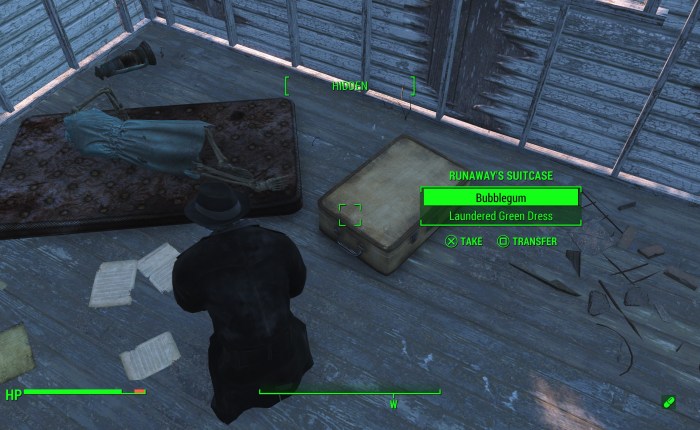
And then I stumbled upon this, while just walking around.

The Ranger Cabin near Sanctuary. The character kneeling beside the mattress is mine, wearing a nostalgia crime fighter’s outfit that I earned in an earlier mission.

For those who don’t know Fallout 4 lore, the game is based in a world 210 years after a nuclear war occurred. On October 23, 2077, a massive nuclear exchange destroyed much of the world, leaving behind radiation, devastation, and a severely reduced population. Many of the survivors had sought shelter in underground vaults, which is where our playable character comes in, as a survivor of Vault 111. The game starts in 2287, with hundreds of years having led to many changes as people have tried to rebuild and the power struggles of empires big and small affect everyone living in the remains of the world.

In that image is the skeleton of a young girl who is never identified in game, but the game resources list her name as Abigail. On October 22, 2077, she had a huge argument with her parents that resulted in her leaving the house and coming back to this cabin, a safe childhood memory, to be able to sleep safely while she thinks. It’s not said explicitly but it’s strongly implied that she’s pregnant, to some guy called John who she doesn’t feel she can tell, and her voice recording is of a distressed young woman who’s got out of somewhere to sort herself out.

That’s her skeleton lying on the mattress, in an old dress. Next to her is her suitcase, which contained the recording of her statement, a change of dress, and some bubblegum. I didn’t think much of this until I collected the holotape and played it, then I walked back into the cabin and just looked at the skeleton. The bubblegum in the suitcase.

She ran away on the 22nd. On the 23rd, the bombs dropped, obliterating almost all life in the region and it was this, most certainly, that killed her. The bombs dropped at 9:47am in the game. Given how much had gone on and the position that she’s in on the mattress, perhaps she was still asleep at that time, marshalling her strength for whatever was going to happen when she woke.

Games are full of little tragedies like this, emotional embellishment that is not a strong support for the story but gives you a real feeling for the world. When this is done in an over-the-top or awkward manner, it often degenerates into pastiche, losing the pathos that should be associated with it. It is also, however, very easy for these to slide into the background when you are focused on in-game achievement, or have become desensitised to the images presented. If these game design elements are to engage you, you need to be aware that they exist and be prepared to deal with them as the tragic elements that they are. But you also need to be prepared for them to hit you where you live.

Looking at the skeleton on the mattress, I felt the same aesthetically driven sadness that I had on my first playthrough. I could keep doing what I was doing in the game but I couldn’t actually change the world to make it better. I couldn’t tidy up the cabin, dig a grave and bury her, or even seal the door and stop it from being disturbed. I could listen to her tape, steal her bubblegum, and either wear or recycle her dress. It just felt that she deserved more than this, which is a weird thing to say about software generated polygons but here we are.

Now, of course, nothing I was doing in game was actually making any real difference to the world. I was playing a game, and while there’s nothing wrong with that, and then I was reminded that this young woman’s story is being repeated, every day, in the world. The supermutants aren’t real, the synths aren’t real, the 2077 war isn’t real, but this story, someone rejected by her family, feeling alone, and being far from help when a terrible thing happened – that’s happening right now. And I felt that, looking down on that skeleton and thinking about a scared kid stuffing a dress and some bubblegum into a suitcase and running out to find somewhere that she could just breathe without being yelled at.

This run ends here.

I will play this game again, I imagine, when I’ve got some distance. But this run ends here and I’ve moved my game to backup storage to spend some more time back in the world. Now I need to act on the ways it made me think.

Yesterday, we donated groceries to Catherine House, a fantastic group who provide support for women experiencing homelessness in South Australia, and I updated my microloan and charity portfolios to provide more support to women and girls seeking to build new lives, looking for shelter and support, and who were in need of help. There’s always more to do.

More information on the in-game runaway.

If you’re interested, you can see more details of her here in the Fallout wiki, and read her transcript here.

Guest Editorial published!

The March/April issue of Analog Science Fiction and Fact now contains roughly 2,000 words of me, talking about whether we could inspire people about education using the same inspirational approaches that introduced going to outer space and planetary exploration.

This has brought a number of people past the blog and my novel from last year “The Curse of Kereves Dere“, which has been a nice surprise. I think I’ve had an extra sale! (At the rate I sell books, that’s more than a percentage point increase.) I’ve also received some feedback telling me it’s utterly stupid and some saying that they think it’s a wonderful idea. I guess that always happens when you go public.

I have started working with some other academics on ways that we can provide useful information on 21st century teaching to writers; we’re looking to produce a resource that will give you the background you need to add excellent educational detail to your stories. I can’t ask you to talk more favourable about education and not support it, can I?

On the writing front, I’m still slowly writing my next novel and I’m trying to get that finished soon but my day job is taking priority right now and, because I’m a University academic helping my students to get the most out of Computer Science, it’s a priority that I can’t ignore. But I promise that you’ll have “Meditations on the Vampire Republic” before the end of the year.

Thank you for dropping by! Please keep following for more information on resources related to my guest editorial and news of my books.

Upcoming guest editorial in Analog

I’m very excited to be able to let you know that I have a guest editorial coming up in the March/April issue of Analog Science Fiction and Fact, where I talk about how we could use story telling, design fiction specifically, to get people excited about new directions in education and, maybe, save the world with free, high-quality education for all. (You should all make Trevor and his team happy by buying that issue of Analog! 🙂 )

Of course, because of when I wrote the editorial, I was unaware of the movie “Hidden Figures” but I’m very excited to see all of the people involved in the space program being recognised for their contributions. Here’s to a time when we record everyone’s involvement honestly and up front, regardless of gender, race, orientation or religion.

I’m working on my next book, with an aim to get “Meditations on the Vampire Republic” out in the second half of 2017.

Happy New Year, everyone!

He’s my Cap, too, and he’s never hailing.

This post is full of spoilers regarding the most recent Captain America comic (#1) and its revelations. There are also Star Trek II: Wrath of Khan (TOS) and Star Trek II: Into Darkness (Reboot) spoilers. If that’s a problem, please stop reading now.

Still here?

Great.

There’s been a lot of discussion about the revelation that Captain America is, somehow, a long-term sleeper agent for Hydra. Now, I usually take a live and let live approach to Internet discussions because I don’t have a great deal of free time. But this one went somewhere strange and I wanted to talk about it.

There are (roughly) two main camps. There are those who are offended, outraged or upset that Captain America, a character created as the anti-Nazi, is now aligned with an organisation that is a Nazi proxy. There are those who are saying “Eh, it’s comics, they’ll be some big reveal that it’s a parallel universe or a dream. It doesn’t matter. Chill out.”

Look to Twitter, under #SayNoToHYDRACap to see the responses from various participants. (Both Chris Evans and Clark Gregg have, bless them, expressed their surprise, probably to the degree that their delicate relationship with Marvel allows. To two actors who are core to portrayals in the MCU that frame Cap’s movie identity, the Hydra storyline makes no sense.)

The existence of a number of schools of thought is no surprise. Had it stopped there, I wouldn’t be writing this. But the “hey, no problem” camp started to tell the “we’re upset” camp that they shouldn’t be making a big deal of this. Vocally. Repeatedly. Dismissively.

(There’s also been some bad blood coming back the other way, which is unnecessary, but most of what I’ve seen has been ‘hey, chill out’ in a far less friendly manner.)

When you start to tell someone what they can or can’t believe over matters that are effectively perceptual or opinion-based, and how they can and can’t feel about those things? You know, I think we’re going to have a problem. And we can say “it was only a discussion” but the language has been pretty patronising and dismissive.

I wrote to a friend who Facebooked “don’t act like someone crapped in your cornflakes” to say that I was glad his cornflakes were fine but mine didn’t appreciate Nazi imagery being dropped in them.

There are many people out there who have a relationship to Captain America beyond his comic existence. The MCU movies have brought Cap to a lot of people at a time in our world when things are a bit dim. The movie of Civil War took the really rather badly characterised comic series and drew upon the deep relationships that everyone has been building with the screen characters and managed to present a situation where two people who were both right were still at odds. We used to have to read Greek plays to see this, now we can watch it with popcorn and a large Mountain Dew.

It’s a little strange to think that most people’s most extensive exposure to the discussion of ethics and morality is more likely to be on the silver screen than in other places but it’s a fact. Fewer people are reading and studying philosophy. There’s less room for the liberal arts in many curricula. Heck, I’ve assigned “Winter Soldier” as a study of virtue ethics for my students, because there’s enough there for some solid discussion.

There are a number of people on the “it’s ok” side telling people that anyone who hasn’t read the comic can’t have an opinion. And that’s baloney. Apart from the final panels and the pre-release stuff, we have the writer, in this interview, who lays everything out for anyone who hasn’t read it. Here are some quotes:

Spencer says outrage is exactly what he wanted.

“When you decide to do something like this, you understand obviously that people aren’t gonna throw you a party for it,” he says. “You understand that this is the kind of story designed to upset people and shock people and worry people. That’s the response you’re supposed to have to something like this, when you’re seeing a bad thing.”

and

“This is something that is gonna have a profound effect on the Marvel universe,” he says. “I’ve seen a lot of people say things like, ‘Oh, it’ll be wrapped up in the arc,’ or ‘Give it six months.’ And I can tell you, that’s not the case. This has real lasting repercussions that are gonna be with us for a while.”

and

“The story is not Steve’s past, it’s Steve’s future.

So we’ve established that Captain America is Hydra.”

As I’ve noted elsewhere, the writer was expecting people to be outraged because he knew he was attacking one of the most important symbols in the Marvel universe. Anyone who’s asking “Why are these people upset” is missing the point that this is exactly what the creators wanted. Anyone who is saying “oh, it’ll be wrapped up soon” should read that second quote. And then the third. And ask if they want this to be the new forever.

The writer dodges the question about the creators of Cap and how they’d feel, which is understandable as it’s a giant question of how much influence a creator should have on their work if it continues to develop but, at the same time, I think it’s a telling omission. In my opinion, he would have appeared braver had he taken this issue head-on. Cap was created as a symbol of something that perhaps isn’t very realistic but he’s part of a new mythology that is replacing many of our story telling forms. You’re taking something that’s edging dangerously close to a god-myth and making him the adversary. Saying “Hey, people might be upset” could be underestimating what you’re doing with an important symbol.

The first time we see Cap, he’s punching Hitler. It’s 1941, the Nazis are rampaging through Europe and the Nazi’s targets were already being menaced, deported, ghettoised and killed. Cap’s first cover was a message from his creators that Hitler needed to be stopped. Cap was many things but he was not in league with the Nazis.

Why does it matter if reality is so mutable in comics? Look, I know comics love to do this. I chased X-series across the 80s and 90s as people shifted, changed, became other people, lost their skeletons, got turned into cyborgs, got turned back into people, time travelled inside their own son’s fantasy universe under cosmic power, and I know that there’s a DC universe where the Fantastic Four are sentient bananas. I can handle all of that. I read Grendel. I can quote Doctor Manhattan. I know what’s so unfair and infuriating about the depiction of Storm. I can identify most forms of the Beast. I knew Northstar before he came out. I can tell you what killed the evil Clark Kent in the Universe where Lex was Superman. I was deeply saddened by the flower opening power conveyed by the Morituri process. I nearly bit through my tongue at what they did to Cyclops in the movies. I was riding with Judge Dredd from prog 1. I was delighted by the weirdness of Supergod. I read enough of Crossed to know why I didn’t have to read anymore, ever. I understand the medium. I know that the movies are different and there’s a lot of wrong and right in there.

I even know how many weird things have happened to Steve Rogers, the Captain America we currently know in the MCU. Leaving the role, ageing, dying, many others stepping in, and, of course, the one that everyone loves to bring up in this discussion, the time Cap was brainwashed into becoming a Nazi and had a swastika on his shield (Vol 1, National Force storyline, issues 231-234). (Hatemonger also put a swastika on the shield but he was a clone of Hitler, so we’re not surprised. Bad Hatemonger.)

Why is this different?

Firstly, Cap is much bigger than the comics now. That’s not to say that there’s a ‘canon’ Cap either way (not falling into that trap) but there are millions of people who know who Cap is from watching the movies and he is the little man who didn’t like bullies, Steve Rogers. That’s who they see in the role of Cap. And, because this is what Marvel has chosen to do, these people are not wrong. When they see the image of “Hail Hydra”, this is at odds with everything they know about the character. This makes everything a lie. This makes Coulson’s sacrifice and suffering meaningless. This makes the torture Bucky suffered for decades something Cap knew about. Check the Twitter feed. There are some sad people out there.

This makes one of the most good and decent figures in contemporary culture a monster: the friend of five years who slips something into your drink after convincing you to leave your car at his place. The whole time, it’s been an act, to conceal treachery and evil.

Secondly, it’s really not clear if this is brainwashing or Steve Rogers is actually Hydra, ergo evil. If he genuinely believed, the whole time, that being Hydra was the thing to do, then no-one is incorruptible. Yes, this is all make-believe but some symbols are important. You don’t have to believe that the gods are real to take solace from their stories.

Thirdly, this is obviously all to sell comics. Let’s not pretend that a shock like this is anything other than that. There are many ways to explore this storyline for the same artistic value but this one will bring buzz and buzz means sales. But let’s pretend that it’s actually about the art for the purposes of discussion.

I believe that the role of art is to make meaning. I believe that good comics, like any narrative form, are legitimate expressions of art as they bring us new things to consider and new meaning to existing entities in our life. Construction, modification, destruction and rebuilding all have a place in art. Am I saying that Cap is sacred? No. (He may be to some people soon enough, as noted, but right now I think we can agree that a comic-book character can be altered without reality collapsing.)

As an artist, I accept that nothing is sacred in terms of what we can change in order to produce art but I also believe that the benefit must outweigh the cost. Yes, we could have a storyline like this but it requires careful thought on the part of the artist as to what will be achieved through an act of alteration such as this. (Daubism, Dada, and so many other movements have alteration at their core but to do it without sufficient thought is to be a vandal rather than an artist.) We have to think about the implicit contract between artists and the public. We have to think about what art is.

Imagine a time where the Louvre and its collection lose all artistic meaning. Nobody goes to enjoy the art, they only go to say “I’ve been there.” Is there a point where the artistic statement that must be made is to destroy the building and its collection, filming it as it burns and thus turning it back into a form of art? It would be one of the most extreme acts of destruction and, therefore, the artistic merit of the act of destruction must have incredible benefit. (Nobody do this, please, as the Louvre is still widely perceived as being full of art. Think again in ten thousand years.)

A lot of what I see in the alteration, rebooting and re-evaluation of older pieces of culture is a resort to shock and confrontation to try and drive an emotional response. Art can often be shocking but we must remember that a shock is not guaranteed to be art. Comics are serial offenders at the shock game, to the extent that the jaded response to “Hail Hydra” is “Meh, come back next week.” At the same time, there is a deep conservatism that limits some character development. Just before the Hydra story broke, there was a movement to have Cap form a romantic relationship with Bucky. It quickly became apparent that wasn’t on the cards.

Cap is allowed to be a Nazi proxy before he’s allowed to be bi- or gay. That’s actually shocking but not in a good or artistic way. It’s just repulsive.

When all that an art movement has left is shock, it’s probably dead. This is not where want comics to end up. As it stands, this reaction may have had its bluff called in this work. If sensation-seeking is to have sensation, then it cannot be ignored. All those “meh-“sayers may have pushed Marvel to do something drastic to provide real shock and try to awaken tired limbs with a lightning strike instead of a 240V twitch.

One day, someone will really and finally destroy a major franchise and I actually have no idea how everyone will react. But I think that bad reboots will continue to try and prop up income streams, and I also doubt that many people have the moral courage to be a franchise killer in the 21st Century. (Alan Moore is an obvious outlier here. His thoughts on people continuing to stir up his old properties are quite illuminating.)

I remember the end of Star Trek II: Wrath of Khan, where we all thought that Spock had died. For good! Noooooo! (KHHHAAAANNNN!) Yet the anaemic and confusing remake sabotaged any genuine emotion in their pastiche by transferring the act to someone it was hard to care about and then making it so short an event that you could have had a long blink and miss the time the character was dead. Bathetic nonsense that put on borrowed clothes to enact a story badly. There was no art here, just someone trying to make money. Comics can be, and often are, so much better than this, as are their associated properties.

We can revive and alter properties and do it well. There have been three Sherlock Holmes franchises in operation in recent years and none of them are that bad. No-one has to choose between them because they have explored the old stories and the character in different ways. It can be done! Yet, far too often, it is done so terribly badly and we end up with a shock machine that delivers more and more painful shocks to a body that responds less and less, from creeping boredom.

This should be a really positive time for everyone who loves comics. Why? Everyone is talking about a comic character.

This is an incredible time for the comic community and it makes it even sadder how many people are being dismissive of those who fail a worthiness test or who are being judged for, God help us, taking it too seriously. If comics are valid art then people will and must care about what happens. This is a validation of the power of graphic story-telling! Now is not the time to close the clubhouse until someone recites every line of Cap #87, page 7, to prove their ability to hold an opinion on something that they have actually seen with their own eyes.

There could be great art coming from an act such as the “Hail Hydra” storyline but, well, I’m not convinced that it’s worth it. I’ve been promised so much by alternative universe reboots and re-reboots and it has so rarely delivered. I fly a lot and I’ve reached a point where I have no idea where a movie with the word “Spider-Man” in the title fits. I don’t know who I’m going to see or the extent and origin of the powers. The contract between creator and reader is delicate and important. And it has been absolutely stomped on by recent re-re-reboots, ham-fisted attempts to jam new stories into old suits, and shock after shock after shock that ultimately means nothing.

I’ll invoke Chekov. Guns that are present should be fired and that action should be essential.

Although the author ducked the question, my opinion is that the creators would be horrified at this direction, because they sought a hero to take on Hitler and his bullies. They’re on record as seeing Cap as a political creation because they were repulsed by what the Nazis were doing. Even from the first, Cap has been more than a strong man with a shiny shield. He’s been a symbol of good, of freedom and of being against everything that the Nazis stood for. This is never more evident than in the characterisation provided for Steve Rogers by Chris Evans. Watch Steve in Winter Soldier, struggling between orders and rules, as he does what he does best: he tries to be the best man he can be and places himself as a shield between the bullies and their victims. Even when his life is ebbing away, his principles burn as brightly as they ever did.

Now, it appears that Cap is a secret thug and, through his deceit, he has been in support of the bullies all along. For many of us, this is a betrayal of everything Cap meant to his creators and what he has come to mean to so many people through comics and the recent movies. I am not saying that anyone is wrong in saying “I don’t think it’s a big deal” – you’re entitled to your opinion. I am saying that limiting those who can have an opinion to those who read comics is ignoring the larger Captain America mythos and the stellar work that has been going on in the MCU. Telling people how they should feel about an act deliberately designed to shock and offend because it is an attack on a beloved symbol, to be patronising and condescending in the process, is not something that you’re entitled to do, even if you’ve read every single comic and spend the night in a Captain America onesie signed by Simon and Kirby.

Everyone owns a piece of Cap’s myth now. Some of us are upset about the latest direction and we don’t think it was necessary for the storytelling, nor appropriate given the origins. What we perceive, what we feel, and what we think is legitimate.

Your cornflakes may be fine but mine have a giant ass in them. Please don’t tell me to simply eat around it.
 

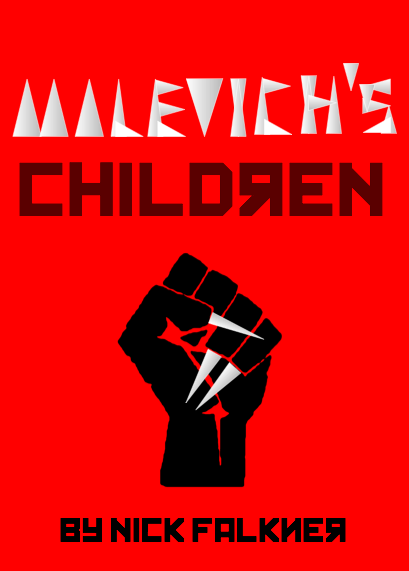
“Dreams. Sonia still had the dreams.” The first words of a new book #amwriting #amediting #malevichschildren #kazimirmalevich

I’m editing my second book, “Malevich’s Children”, at the moment but it’s a long book and I’m making a lot of changes. I’ve been resting occasionally and trying to get a start on a new book, a science fiction detective work, but I’ve been struggling to get the first chapters out. (I’ve also been working overseas for my day job, which means working in two time zones. Not complaining, it’s just a busy time.)

Today, on the long plane ride from Edinburgh back to Australia, a new character popped up and her voice gave me the framing for the start of the new book. She’s going to give the book the heart it needs. Fingers crossed. As many of you will know, these words may not end up in the final draft. In fact, it’s really unlikely that they will (because of the way I write) but I wanted to see them up just to know that I have finally started… the novel that shall be known as “JB”.

In between writing the first words of “JB” and editing “Malevich”, I hope to have another book out in the next six months. Don’t worry, if you watch the Twitter feed, you’ll know about it soon enough.

Until then, here’s the temporary cover for the readers’ copies of Malevich’s Children. If this is your introduction to the works of Kazimir Malevich, he’s worth looking at in detail!

Malevich-Wide-Red

No, not #Prince, too.

Prince_at_Coachella
Prince at Coachella, 2008. Photo by penner – http://flickr.com/photos/penner/2450784866, distributed under CC BY-SA 3.0

2016 has been a difficult year for those of who us who grew up in the 80s. I’m not going to list the names of those we’ve already lost because it’s far too long and I’m starting to become a little scared that the list has enough cosmic weight to become a maleficent summoning.

But we’ve lost a lot of amazing people. People who were good at what they did, people who did what they were good at, even as other people derided them, tried to constrain them, tried to make them hide their glorious eccentricities.

And now Prince is gone. The quirky, brilliant, mercurial, enigmatic, and talented artist who was so clearly defined that people could post a picture of him in yellow and call him “The Purple One”. Multi-instrumentalist, composer, arranger, singer and legend.

My favourite story of Prince was told by his “duty” sound engineer. Prince liked to record at all times and, as a result, he had an on on-call sound engineer to run the studio while he recorded. One night, Prince came in and put down a track based on, I think, a dream and spent hours putting down everything. He listened to it at the end but didn’t like it. He wanted to get rid of it.

The engineer was a fan. He’s seen this amazing thing taking shape and he can’t believe it’s about to disappear. He suggests waiting until tomorrow.

Prince looks at him, smiles, reaches over and deletes the whole thing. Because it wasn’t right and he had enough faith in himself and his abilities to do it again and, next time, get what he wanted. Or to live without it. It had to be right or it just couldn’t be.

Artists have to be brave. Artists have to dare.

Prince worked harder than many people I know to try and produce things that matched what he saw in his head. His craft was honed by practice and performance. His mind was enlivened by constant challenge in the pursuit of his vision.

He was performing up until a month ago and he kept sharing his talent and vision with the world right up until the end.

Deeply respected. Adored by fans and music lovers. Sadly missed, already.

Thank you, for all of the wonderful music and inspiration. Farewell.

New Flash Fiction: “Safe Harbour” #amwriting #flashfiction #fiction

The doctors gave the survivor a metal globe, small enough to fit into her hand, with the features of Earth printed in relief, raised high enough to be discerned by a fingertip.

The survivor has been clutching it ever since, alternating between marvelling at the perceived wetness that the micro-etching of the oceans has generated, and crying silently, water streaming down her face, as she traces her finger from one place to another.

She speaks of her people as one. All customs and culture together.

“My people did this, in wood, for traversing the coastlines of Greenland. The Inuit needed a small map that would float and could be read in the dark. They carved driftwood to represent harbours and you could store it up in your mitten, to navigate or find safe passage in rough water.”

She is descended from the people who lived in China and those who lived in North America. She has no Inuit heritage but now, now that there is no-one else, she clutches the globe and reads the stories and history of a species. She is the one. She is trying to become the all.

We had intercepted her ship roughly a light year out from Earth. She had already resigned herself to oblivion after radio communication stopped. An alien ship was part of what she had prepared herself for.

“Oh, you’ve invaded, then?”

We had seen a lot of movies from Earth. We understood the accusation. But we had to tell her what we had detected on the subspace sensors. The massive shockwave. A cataclysmic event. Her tiny ship, experimental and only supposed to be out and back for three years, did not have the arrays or physics for detection.

We took the “Sagan” into our hold, a shining mote of dust in a warehouse of treasures, and brought her aboard. Then, to Earth, not to fulfil suspicions of invasion, to see what had survived.

The astrophysicists aboard tell me that the new moon will form in a million years or so but it is hard to see in the chaos that reigns there.

She was hopeful until we crossed the heliopause. Then the sensitive gravitometers started showing us the true nature of the event. She retreated to her ship to read through all of the data that was stored about her home.

Our commanders wondered if someone on Earth knew. There was no reason to pack so much information into a research vessel that was supposed to return. There was a surprisingly large amount of food on board.

She doesn’t know. No-one told her and, as far as she knew, nothing was bearing down on Earth.

But an oblivion event, a second Theia, would be an unavoidable certainty. What purpose would be served in telling people when there was no escape? Was it a grand conspiratorial kindness? Did ten billion people look up for an instant, surprised in the middle of the everyday, and then see no more?

Perhaps if we had arrived earlier we could have taken some on board, a breeding population at least, but we did not. We wander. We arrive when we arrive and we had no reason to rush. Space is silent and unreadable until the moments when it is impossibly loud and dreadfully apparent.

We suspect that someone turned an experiment into a lifeboat, prepared for the roughest seas in the hope of a safe harbour. A simple message of “we were here”.

We held station for weeks. Finally, she emerged.

“Let me see.”

We dropped the starboard wall for her. She leaned forward and pressed her forehead onto the fields, opalescent streaks oscillating gently where her skin touched the barrier. We had never seen the tiny lightning displays that accompany water as drops fall down against a field.

For a month after that, she would barely talk. She didn’t return to the “Sagan”. She curled up in one of the lounges and read.

The doctors delved into her culture. Her physical nature was of necessity, rather than the forms we adopt for convenience. We reasoned that the mediation of the physical could allow her to make progress or at least come to terms with the event. We made her the globe.

It is her constant companion as she traces journeys and places over it. Here is the Mayflower, there the ocean trek of the early Polynesians, here humans first entered space, this pinprick pressure on her thumb is the greatest mountain in the world. This was her house.

“This was my house,” she said, holding it up in front of one of us. Electronic eyes peer down into the microstructural depths of the globe and she is close, perhaps only a thousand kilometres off. But it is not important. We can see the look in her eyes as she holds up the map of her old home.

We wander. We witness. We see that look, its equivalent in gesture or signal, on many of those that we encounter. It is looking to the future.

Her request is easy enough to fulfil. Giant chunks of matter turn in the microgravity of orbit, ejected from the surface by the impact, and some of them hold wood.

She asks for a branch but we store a forest or two. She will be travelling with us for a while.

The first map she carves shares features with the globe we made. The smoothed piece of wood is light, small enough for one hand, and she carves an array of little hemispheres, a large one at the centre. She pays special attention to the fourth hemisphere out. When she is finished, she has carved perhaps a quarter of one side of the stick. Room for more. She sits in the command chair she has taken from the “Sagan”, up on our bridge, stick and carving knife by her side.

She runs her fingers lightly over her carved map as the engines engage and Earth slowly fades away.


Afterword:

This piece lacked a hook and then a friend posted an article on the Greenland wooden maps that had been used for generations, to make safe passage in rough seas. The maps we make reflect our perception of the world and our place in it. The map is not the territory (Korzybski), it is simultaneously so much more and less. Thank you for reading!

If you enjoyed this, you can find my collection of short stories “Five Stories: Track One” and my new novel “The Curse of Kereves Dere” on Kindle, iBooks and Smashwords.

Help! My author friend has asked me for feedback. What do I do? #amwriting #amlaughing

Let’s assume that, despite your earlier attempts to convince your friend that you’ve read the book and not managing to stay away from the problem in the first place, you not only still have a friend who’s a recent author but this so-called friend has now turned on you like an angry viper and asked you for some feedback on the work.

Dear, oh dear, oh dear. Lucky for you that I have a PHD in apparently genuine and useful feedback. Technically, a Partially Hypertense Deltoid shows how caring I am and, for once, this is a useful qualification.

Why am I back here? You give the worst advice in the world.

Because you have nowhere else to go. Shall we begin?

Help! My author friend has asked me for feedback. What do I do?

1. I think this is a bad idea. Is there any way out of this?

Well, no, probably not but that assumes that you have actually been asked. Sometimes authors talk about their work but this does not actually require you to solve the problems that they mention; they’re just venting in the company of friends.

Sometimes people just want to see if you like something. Fiction is weird and writing is harder than many people think. Many authors will go through a stage where they want a friendly voice to let them know that they wrote something that is recognisable as writing. Could you read it? Was it enjoyable? Did you struggle at any point? What was the best bit for you? All of these can be quickly provided and it is, trust me, very helpful.

But when someone says something like “I’d really like you to read this and see what you think”, then you’re going to have to make a choice. If you agree to do it, then you’re going to have to potentially deliver bad news if it’s no good. But if you say that you don’t want to do it, then that can have all kinds of downsides.

Basically, asking someone else for feedback is a little like working out details for an initial romantic encounter. You both should be comfortable with the discussions and no-one should be overly surprised by the timing or nature of any requests. The pacing and outcome should be be mutually satisfying.

Walking up to strangers and whispering “I like rubber” is frowned on in many cultures and for good reason. (Unless you live in a place with lots of rubber trees, where it’s still a little weird but you might get away with it. Please don’t quote me.)

2. Ok, I’ve read some of it. Can I say that I think it’s just a rip-off of…

Yes. Absolutely. As long as you don’t want to talk to that person again.

What? What do you mean?

I mean AHHHHH! No! No no no no no! You want to tread very carefully whenever you want to say “Hey, it’s like this…” or “Wow, didn’t Niven…” or “This is Star Trek with furries. Again.” Homage, the deliberate allusion to or imitation of another artist or work, is a well-defined part of writing, as are satire, in-jokes, tropes and trope inversions.

Through a Jungian lens, there are apparently only seven plots, although there could actually be three, twenty or thirty-six, depending on who you read. There are always going to be similarities and it’s probably important to work out if these similarities are striking you because they’re such deeply engrained parts of a culture or because your friend has (accidentally or not) rewritten Lord of the Rings with beautiful, long-lived Belves, short and tough Bworfs, and cunning folk with hairy feet called … Bobbits.

Now is a good time to ask your friend what her or his inspiration was. Many people who are consciously writing work that relies on others will happily admit to “filing off the serial numbers” or “wanting to write Lord of the Rings as something other than Epic Winnie the Pooh”. (Moorcock’s actual description of LotR, by the way.)

If your friend has asked for feedback, then they’re probably not after value judgements on the whole. They may even have given you some guiding questions. If one of the guiding questions is “Is it too obviously still too Twilight” then you are on your own. I cannot help you with that one.

3. Amazingly enough, my friend actually had some questions. I’m not sure that my answers are going to make them happy. How honest should I be?

I want to say 100% honest, “Gertrude Stein to Hemingway” honest, because it’s only through utter honesty that any writer is going to get the most from another reader.

But.

But we must always consider the fragility of humans and relationships in these matters. If someone says “I want you to be 100% honest”, then you are going to have to decide, based on who you are and who they are, how much you can do that.

And this is where objectivity and knowledge are really helpful. If one of the other writers I know and respect gave me detailed feedback on characterisation and pointed out where I’d got it wrong, they’d do so in order to make it better and I can most likely trust their judgement. If someone else said “Hey, you just ripped off Lovecraft. How lame.” then it’s not helpful and, despite it being their 100% honest opinion, it’s a crock.

Can you back up your ideas with evidence, suggest alternatives, and help to make it a better book? Try for honesty.

4. This seems less facetious than previous guides. What’s so important about good feedback?

It would be very easy to come up with a lot of cheap gags about feedback but writing large works is a difficult and relatively lonely venture for many people. If someone is asking you for feedback, then they’re asking you to be part of something that’s quite important for them. I love the use of humour for framing and lightening discussion but, despite everything else in the previous guides, if you agree to give feedback, then you have to understand that the other person has made themselves quite vulnerable.

Are you suggesting that we use our ‘best’ honesty?

I am the Prince of Lies. Such chicanery seems apt.

5. I’m uncomfortable with your current position in this discussion. You haven’t directly plugged your book or made me feel that I was heading towards eternal damnation. Now I’m worried that there’s some sort of giant sucker-punch of cheap gags and self-promotion waiting in my future. Can you tie everything together with a rough guide to giving feedback?

Opinions are like…

Without mentioning assholes. Which is like an Oulipo challenge for you.

Um. Ok. Everyone who reads your work will have an opinion but these opinions vary greatly in the positive effect that they’d have on your writing. Five minutes work with another human can create a baby in nine months. Five minutes work won’t even get you a good book title in writing and it certainly won’t grow into a novel over a year. Most people have no idea how much work it takes to write, nor can they readily accept the sheer volume of thinking that went into writing. When someone asks for feedback they have asked you to look at months, years or decades of their life and give your thoughts on both how that time investment went and how its fruits could be made sweeter. Not everyone gives good feedback and not everyone will give good feedback to a certain person. My friend Michael suggests that we all find that best, truest, most honest and brutal critic for all of us: our own Gertrude Stein.

I have a group of people who help me with that, a patchwork critic I refer to as my Franken-Stein.

I hate you.

But it helped so much in writing my recent novel, The Curse of Kereves Dere!

And you’re feeling better. Tune in next time when Nick talks about …

Hey! That’s my line! Next time, I will cover the even more difficult issue “Help! Someone I know has written the worst book in the world!”

Finally, a reason to quote excerpts from your book.

behind you


Help! How do I pretend that I’ve read my friend’s book?

Oh, dear. You didn’t read yesterday’s excellent advice about how to deal with a new author, did you? Or perhaps you did but, in a weak moment, you discussed someone’s new book with them. To their face. In a way that may have, for the best of reasons, given them the impression that you have or you are about to actually read their work

The easiest option is, of course, to read the book but time is short, life is busy, and it hasn’t happened. But you don’t want to hurt your friend’s feelings, especially if they have abandoned all pretence of civility and asked you outright if you’ve read it.

Perhaps you said you were going to read it. Several times. And now the dreadful moment has arrived. Luckily for you, I am a dreadfully cynical flim-flam artist and humbug, and I can help you to successfully convey the impression that you have read your friend’s book.

Help! How do I pretend that I’ve read my friend’s book?

  1. Oh God, oh God, how do I start? She/he is waiting for me to speak!

    The first thing to remember is that authors often release lots of details about the book in order to get people to read it in the first place. Synopses, titles, blurbs and the like are rich veins to mine for those who are looking for useful guides to the content.Remember those nouns you remembered from when you foolishly asked what the book was about? Let’s say that you remember the term “Soviet Union”.

    “I hadn’t thought about the Soviet Union in that way.”

    (This is technically true. You hadn’t thought about the Soviet Union in any way but, boy, are you thinking about it now.)

    This will probably generate a large volume of additional detail from the author, which you can then noun-mine for more helpful sentences.

    (Some authors are difficult and will ask ‘In what way?’ because they wish to defy the conventions of decent society and demand actual information from you. Feel free to fake a seizure, collapse to the floor, and then never see them again. If you are in a relationship with them, this may not work as well.)

  2. What if I don’t remember anything?

    This is trickier. You’re going to have to make general statements that are true of any good book.

    “I couldn’t put it down!” is true if you never picked it up.

    “The ending was great!” The author wrote the ending. Chances are that she or he liked it too. If the author follows up with “You didn’t think it was too (insert adjective here) “, simply smile and shake your head firmly. “No, I never thought that.” (Because you never thought about it at all.)

    “After this book, I’m really keen to know what you plan on writing next.” is sneaky and effective as hell. Most authors are thinking of the next book when other people are doing things like talking to other people, breathing, or putting their clothes on. In describing the next book, the author may well refresh the details of the current book you’ve forgotten, which allows you to noun-mine. See Point 1.

  3. Whew! I have some nouns again! What do I do now?
    Most people love their characters. If you can remember anything about the characters, talk about them. Characters mentioned in pairs are usually at least compatriots and possibly lovers, although they could be adversaries. But they have a connection.

    You: “Really interesting interaction between Kerry and Bosco.”
    Author friend: “Bosco was a lot of fun to write.”
    You: “I can believe that!”

    Are there interesting places? A convenient picture on the cover? A hint in the title? Talk about places.

    “What made you think of St Paul’s?”

    “I love London as a location.”

    “Earth is a good planet to write into books.” (This last one is possibly a little too general and may not work for science fiction and fantasy. Tread carefully if there are spaceships or dragons on the cover. Run like hell if there are spaceships and dragons on the cover.)

  4. I don’t think she or he is buying it. What do I do now?

    Right now, you’re probably wishing you read the book. Generalisation hasn’t worked and the spectre of doubt looms. But we are steeped in blood so far that, were we to go no further, returning would be as arduous as going onwards. We have entered the Heart of Darkness and you can’t stop now.

    Are you the devil?

    No, but we have summer houses in the same tax haven. Moving on. You are going to have to quickly come up with a reason to whip out your phone and go to the website for the work, or find any reviews that have been published.

    For example, from this site advertising a recently published and excellent work, we find the text:

    Kerry and Bosco have powerful allies: Williams and Fauve, London’s most unusual booksellers, and Doctor Jenny Cavendish, the deadliest archaeologist in England.

    Now we can quickly form the following questions:

    “What inspired you to make Williams and Fauve booksellers?”
    “Come on, confess, how much Indiana Jones inspiration is there in Doctor Cavendish?”
    “They’re an unusual ensemble for protagonists. What made you think of that?”

  5. I don’t think you’re a nice person at all. This is a shallow attempt to make me feel that I can fake my way through knowing a book and my author friend has seen straight through me. High level generalisations and embellishment of facts are not sufficient at this level of communication! Nobody trust this man! He is a mountebank and charlatan! And I suspect he is an incarnation of evil. But I still need his help in resolving a situation. What can I do now?

    Probably the best thing to do is to actually read the book. If you don’t have one of your friend’s books to hand, may I recommend “The Curse of Kereves Dere“, available from where many good (and any number of terrible) e-Books are sold?

    You are a true fiend.

    You misspelt friend.

    I know what I wrote.

Tune in next time for more useful advice from Nick Falkner, “Help! My author friend has asked me for feedback. What do I do?

books-683897_960_720
Words. Paper. Book. Yeah!